 anotemy
Sign in
Try it free
Biceps Brachii — Anatomy Notes, Diagram & Quiz
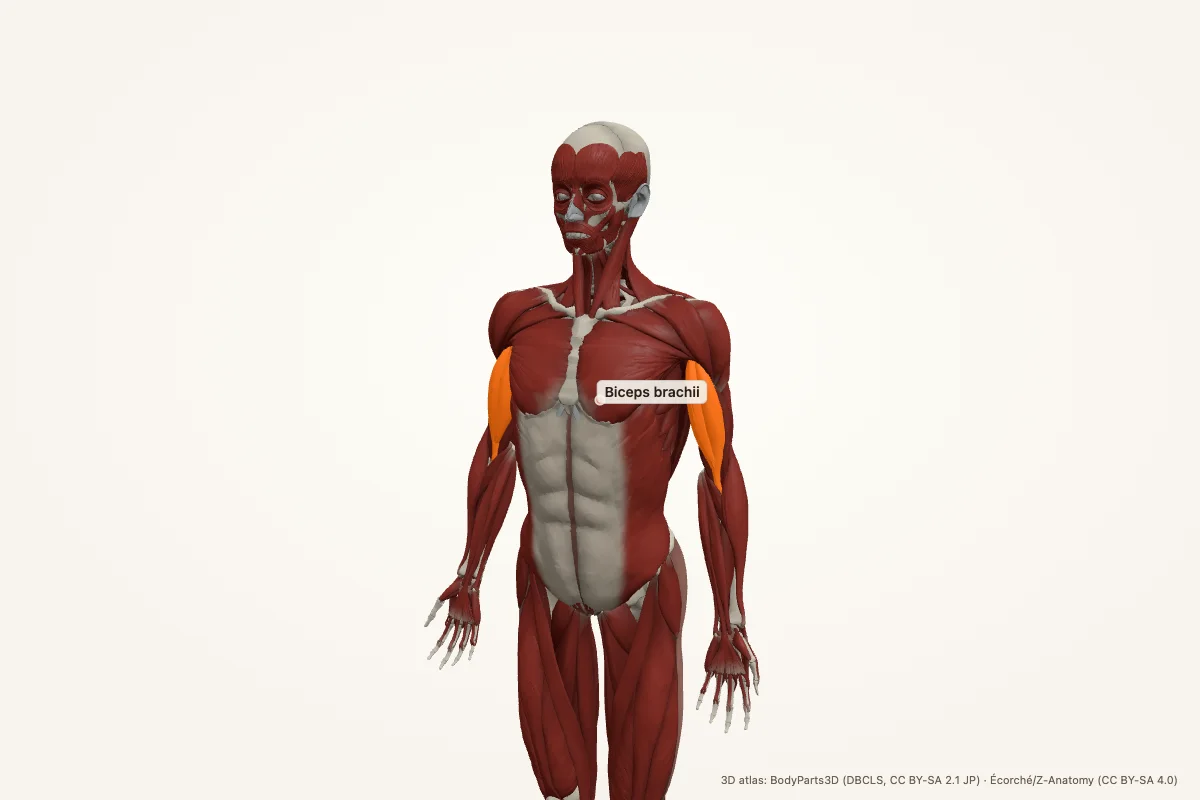
The biceps brachii is a two-headed muscle of the anterior arm. It flexes the elbow and supinates the forearm; the short head also helps flex the shoulder. It is innervated by the musculocutaneous nerve (C5–C6) and inserts on the radial tuberosity and bicipital aponeurosis.
Key facts
| Region | Anterior arm |
|---|---|
| Heads | Long head and short head |
| Origin | Long head: supraglenoid tubercle; short head: coracoid process |
| Insertion | Radial tuberosity and bicipital aponeurosis |
| Action | Elbow flexion, forearm supination, shoulder flexion |
| Innervation | Musculocutaneous nerve (C5–C6) |
| Blood supply | Brachial artery |
| Clinical | Tendon rupture, tendinitis, Popeye sign, bicipital aponeurosis protects the brachial artery |
Where is the biceps brachii located?
The biceps brachii lies in the anterior compartment of the arm, superficial to brachialis and the humerus. It forms the visible bulge of the front of the arm. Its two heads converge into a common belly and a strong distal tendon.
The long head tendon passes through the shoulder joint and runs in the intertubercular groove of the humerus. The short head arises from the coracoid process and lies more medial. The muscle is covered by the brachial fascia and the bicipital aponeurosis distally.
Origin and insertion
The long head arises from the supraglenoid tubercle of the scapula. The short head arises from the coracoid process, together with coracobrachialis. Both heads join and insert mainly on the radial tuberosity of the radius.
A broad aponeurosis, the bicipital aponeurosis, extends from the distal tendon into the deep fascia of the forearm. It covers the brachial artery and median nerve at the cubital fossa, which is why it is sometimes called the “grace of God” tendon.
Action
The biceps is a powerful supinator of the forearm, especially when the elbow is flexed. It also flexes the elbow. Because the long head crosses the shoulder joint, it assists shoulder flexion and helps stabilise the humeral head.
The biceps is not the only elbow flexor: brachialis is the main flexor, and brachioradialis also flexes the elbow. The biceps is most effective when the forearm is supinated, which is why it is tested with the palm facing up.
Innervation and blood supply
The biceps brachii is innervated by the musculocutaneous nerve, with roots from C5 and C6. The nerve pierces coracobrachialis, travels between biceps and brachialis, and continues as the lateral cutaneous nerve of the forearm.
Blood supply comes from branches of the brachial artery, including the muscular branches and the bicipital artery. Venous drainage follows the brachial veins. Lymphatics drain to the axillary nodes.
Clinical relevance
- Biceps tendon rupture: the long head can rupture at the shoulder, causing a “Popeye” deformity.
- Bicipital tendinitis: pain in the anterior shoulder, often with overhead activity.
- Distal biceps rupture: loss of supination strength and a retracted muscle belly.
- Bicipital aponeurosis: protects the brachial artery during venepuncture at the cubital fossa.
- Musculocutaneous nerve injury: weak elbow flexion and sensory loss over the lateral forearm.
- Speed’s test: resisted shoulder flexion with the elbow extended tests the long head of biceps.
Memory aid: flex, supinate, musculocutaneous
Biceps = elbow flexion + forearm supination. Innervation: musculocutaneous nerve (C5–C6).
Long head: supraglenoid tubercle. Short head: coracoid process. Insertion: radial tuberosity and bicipital aponeurosis.
Biceps brachii quiz
Five questions. Open each answer after you commit to a response.
-
Where does the long head of biceps originate?
Reveal answer
The supraglenoid tubercle of the scapula.
-
Where does the short head originate?
Reveal answer
The coracoid process of the scapula.
-
Where does the biceps insert?
Reveal answer
The radial tuberosity and bicipital aponeurosis.
-
Which nerve innervates the biceps?
Reveal answer
The musculocutaneous nerve (C5–C6).
-
What is the main action of the biceps?
Reveal answer
Elbow flexion and forearm supination.
Common questions
Where is the biceps brachii located?
The biceps brachii is in the anterior compartment of the arm, superficial to brachialis and the humerus. It has a long head from the supraglenoid tubercle and a short head from the coracoid process, and it inserts on the radial tuberosity.
What does the biceps brachii do?
It flexes the elbow and supinates the forearm. The long head also assists shoulder flexion and helps stabilise the humeral head. The biceps is especially effective as a supinator when the elbow is flexed.
Which nerve innervates the biceps?
The musculocutaneous nerve (C5–C6) innervates the biceps. It pierces coracobrachialis, runs between biceps and brachialis, and continues as the lateral cutaneous nerve of the forearm.
What is the bicipital aponeurosis?
The bicipital aponeurosis is a broad fibrous expansion from the distal biceps tendon into the forearm fascia. It covers the brachial artery and median nerve at the cubital fossa and protects them during venepuncture.
What is a Popeye deformity?
A Popeye deformity occurs when the long head of biceps ruptures and the muscle belly retracts distally. The arm looks bunched, especially when the elbow is flexed. It is common in older adults with tendon degeneration.
Is the biceps the main elbow flexor?
No. Brachialis is the main elbow flexor. The biceps is a powerful supinator and also flexes the elbow, especially with the forearm supinated. Brachioradialis also contributes to elbow flexion.
Sources
- Standring, S. (ed.). Gray’s Anatomy, 42nd edition. Elsevier, 2020.
- TeachMeAnatomy — Biceps brachii
- Kenhub — Biceps brachii
- StatPearls / NCBI Bookshelf — biceps anatomy search
3D atlas and image credits
Anatomy models: BodyParts3D, © Database Center for Life Science (DBCLS), CC BY-SA 2.1 Japan. Écorché by Charleeh, derived from BodyParts3D and Z-Anatomy, CC BY-SA 4.0. Rendered in anotemy. Changes: highlighting, framing, labels and background removal. Images: CC BY-SA 4.0.
The 3D models are third-party assets under Creative Commons share-alike licences. They keep those licences; the page text is separate. If you reuse an image, keep the attribution and the share-alike licence.