 anotemy
Sign in
Try it free
Rotator cuff — Anatomy Notes, Diagram & Quiz
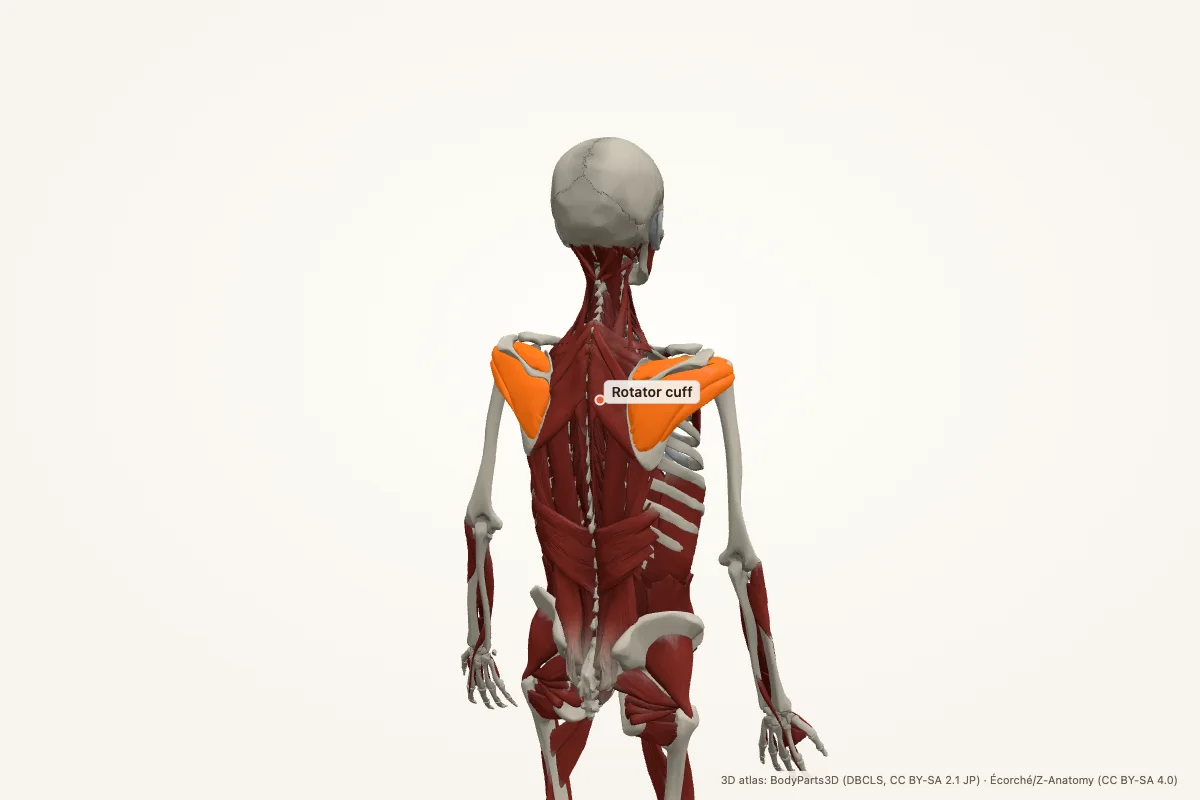
The Rotator cuff is located in the shoulder. Stabilizes shoulder joint and enables arm rotation. Rotator cuff consists of four muscles: supraspinatus, infraspinatus, teres minor, subscapularis.
Key facts
| Location | Shoulder |
|---|---|
| Main function | Stabilizes shoulder joint and enables arm rotation. |
| Layer | deep muscles |
| Key fact 1 | Rotator cuff consists of four muscles: supraspinatus, infraspinatus, teres minor, subscapularis. |
| Key fact 2 | Rotator cuff tendons blend with the shoulder joint capsule to provide dynamic stability. |
| Key fact 3 | Rotator cuff injury commonly affects the supraspinatus tendon, causing painful arc syndrome. |
Where is the Rotator cuff located?
The Rotator cuff is located in the shoulder.
Rotator cuff consists of four muscles: supraspinatus, infraspinatus, teres minor, subscapularis.
What does the Rotator cuff do?
Stabilizes shoulder joint and enables arm rotation.
Rotator cuff tendons blend with the shoulder joint capsule to provide dynamic stability.
What to know for exams
- Rotator cuff consists of four muscles: supraspinatus, infraspinatus, teres minor, subscapularis.
- Rotator cuff tendons blend with the shoulder joint capsule to provide dynamic stability.
- Rotator cuff injury commonly affects the supraspinatus tendon, causing painful arc syndrome.
It belongs to the deep muscles layer. Learn its location, relations, and the structures it works with.
Clinical relevance
Rotator cuff injury commonly affects the supraspinatus tendon, causing painful arc syndrome.
Link the rotator cuff to its blood supply, innervation and relations. That is how exam questions usually test it.
Memory aid: Rotator cuff
Rotator cuff consists of four muscles: supraspinatus, infraspinatus, teres minor, subscapularis. Rotator cuff tendons blend with the shoulder joint capsule to provide dynamic stability. Rotator cuff injury commonly affects the supraspinatus tendon, causing painful arc syndrome.
Chain it as location → function → clinical link when you revise.
Rotator cuff anatomy quiz
Five questions. Open each answer after you commit to a response.
-
Where is the Rotator cuff located?
Reveal answer
Shoulder
-
What is the main function of the Rotator cuff?
Reveal answer
Stabilizes shoulder joint and enables arm rotation.
-
Give one key fact about the Rotator cuff.
Reveal answer
Rotator cuff consists of four muscles: supraspinatus, infraspinatus, teres minor, subscapularis.
-
Give another key fact about the Rotator cuff.
Reveal answer
Rotator cuff tendons blend with the shoulder joint capsule to provide dynamic stability.
-
What clinical link is associated with the Rotator cuff?
Reveal answer
Rotator cuff injury commonly affects the supraspinatus tendon, causing painful arc syndrome.
Common questions
Where is the Rotator cuff located?
The Rotator cuff is located in the shoulder. Rotator cuff consists of four muscles: supraspinatus, infraspinatus, teres minor, subscapularis.
What does the Rotator cuff do?
Stabilizes shoulder joint and enables arm rotation. Rotator cuff tendons blend with the shoulder joint capsule to provide dynamic stability.
What is a key fact about the Rotator cuff?
Rotator cuff injury commonly affects the supraspinatus tendon, causing painful arc syndrome.
What layer does the Rotator cuff belong to?
It belongs to the deep muscles layer of the body.
What should I remember for exams?
Rotator cuff consists of four muscles: supraspinatus, infraspinatus, teres minor, subscapularis. Rotator cuff tendons blend with the shoulder joint capsule to provide dynamic stability. Rotator cuff injury commonly affects the supraspinatus tendon, causing painful arc syndrome.
Sources
- Standring, S. (ed.). Gray’s Anatomy, 42nd edition. Elsevier, 2020.
- TeachMeAnatomy — anatomy library
- Kenhub — anatomy library
- StatPearls / NCBI Bookshelf — Rotator cuff search
3D atlas and image credits
Anatomy models: BodyParts3D, © Database Center for Life Science (DBCLS), CC BY-SA 2.1 Japan. Écorché by Charleeh, derived from BodyParts3D and Z-Anatomy, CC BY-SA 4.0. Rendered in anotemy. Changes: highlighting, framing, labels and background removal. Images: CC BY-SA 4.0.
The 3D models are third-party assets under Creative Commons share-alike licences. They keep those licences; the page text is separate. If you reuse an image, keep the attribution and the share-alike licence.