 anotemy
Sign in
Try it free
External oblique — Anatomy Notes, Diagram & Quiz
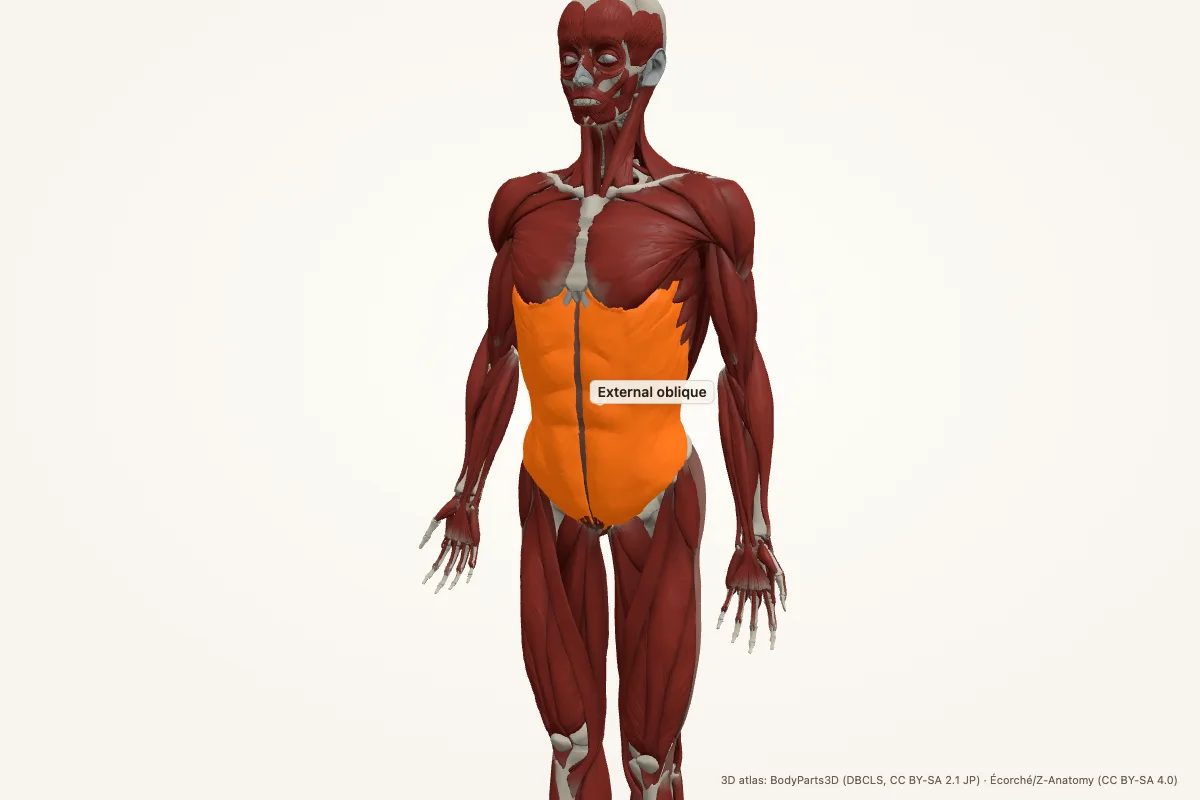
The External oblique is located in the lateral abdominal wall. Compresses abdomen, flexes and rotates trunk. The External oblique compresses the abdominal contents and flexes and rotates the trunk.
Key facts
| Location | Lateral abdominal wall |
|---|---|
| Main function | Compresses abdomen, flexes and rotates trunk. |
| Layer | superficial muscles |
| Key fact 1 | The External oblique compresses the abdominal contents and flexes and rotates the trunk. |
| Key fact 2 | The External oblique is the largest and most superficial of the three flat abdominal muscles. |
| Key fact 3 | External oblique strain can occur in sports involving twisting movements. |
Where is the External oblique located?
The External oblique is located in the lateral abdominal wall.
The External oblique compresses the abdominal contents and flexes and rotates the trunk.
What does the External oblique do?
Compresses abdomen, flexes and rotates trunk.
The External oblique is the largest and most superficial of the three flat abdominal muscles.
What to know for exams
- The External oblique compresses the abdominal contents and flexes and rotates the trunk.
- The External oblique is the largest and most superficial of the three flat abdominal muscles.
- External oblique strain can occur in sports involving twisting movements.
It belongs to the superficial muscles layer. Learn its location, relations, and the structures it works with.
Clinical relevance
External oblique strain can occur in sports involving twisting movements.
Link the external oblique to its blood supply, innervation and relations. That is how exam questions usually test it.
Memory aid: External oblique
The External oblique compresses the abdominal contents and flexes and rotates the trunk. The External oblique is the largest and most superficial of the three flat abdominal muscles. External oblique strain can occur in sports involving twisting movements.
Chain it as location → function → clinical link when you revise.
External oblique anatomy quiz
Five questions. Open each answer after you commit to a response.
-
Where is the External oblique located?
Reveal answer
Lateral abdominal wall
-
What is the main function of the External oblique?
Reveal answer
Compresses abdomen, flexes and rotates trunk.
-
Give one key fact about the External oblique.
Reveal answer
The External oblique compresses the abdominal contents and flexes and rotates the trunk.
-
Give another key fact about the External oblique.
Reveal answer
The External oblique is the largest and most superficial of the three flat abdominal muscles.
-
What clinical link is associated with the External oblique?
Reveal answer
External oblique strain can occur in sports involving twisting movements.
Common questions
Where is the External oblique located?
The External oblique is located in the lateral abdominal wall. The External oblique compresses the abdominal contents and flexes and rotates the trunk.
What does the External oblique do?
Compresses abdomen, flexes and rotates trunk. The External oblique is the largest and most superficial of the three flat abdominal muscles.
What is a key fact about the External oblique?
External oblique strain can occur in sports involving twisting movements.
What layer does the External oblique belong to?
It belongs to the superficial muscles layer of the body.
What should I remember for exams?
The External oblique compresses the abdominal contents and flexes and rotates the trunk. The External oblique is the largest and most superficial of the three flat abdominal muscles. External oblique strain can occur in sports involving twisting movements.
Sources
- Standring, S. (ed.). Gray’s Anatomy, 42nd edition. Elsevier, 2020.
- TeachMeAnatomy — anatomy library
- Kenhub — anatomy library
- StatPearls / NCBI Bookshelf — External oblique search
3D atlas and image credits
Anatomy models: BodyParts3D, © Database Center for Life Science (DBCLS), CC BY-SA 2.1 Japan. Écorché by Charleeh, derived from BodyParts3D and Z-Anatomy, CC BY-SA 4.0. Rendered in anotemy. Changes: highlighting, framing, labels and background removal. Images: CC BY-SA 4.0.
The 3D models are third-party assets under Creative Commons share-alike licences. They keep those licences; the page text is separate. If you reuse an image, keep the attribution and the share-alike licence.