 anotemy
Sign in
Try it free
Best Anatomy Apps for Medical Students
For most medical students in 2026, Complete Anatomy is the best full 3D atlas for detailed gross anatomy on native apps, while anotemy is the best free option for anatomy notes with 3D linked from typed words. Visible Body Suite is a budget-friendly $34.99/year pick with flashcards and quizzes.
We make anotemy, and we read every other app's own pages on 2026-10-26 to get these facts; prices change.
How we picked
We compared six apps — Complete Anatomy, anotemy, Visible Body, BioDigital, Kenhub, and Anki — each from its own pages, focusing on 3D model quality, note-taking, quizzes, price, and platforms. We make anotemy, so we are not an unbiased referee, but we ranked a full 3D atlas first because that is what most students ask for.
- 3D detail: male and female gross anatomy, microanatomy, radiology, and whether the model is dissectible.
- Notes: whether you can type or hand-draw notes and link them to structures, or import PDFs.
- Quizzes: built-in quizzes, flashcards, and spaced repetition.
- Price: free tiers, trials, annual vs one-time costs, and hidden limits.
- Platforms: native iPhone/Android, iPad, desktop, or web access.
- We did not test every feature, only what each vendor publishes.
1. Complete Anatomy — best for full 3D gross anatomy on native apps
Complete Anatomy from Elsevier’s 3D4Medical is the most detailed interactive 3D atlas for medical students who want a complete male and female model with guided courses, dissections, and radiology. It runs as native apps on iPad, iPhone, Mac, Windows, and Android, but individual web access is still institutional-only.
The price is a $39.99 first year then $74.99/year for the Student plan on the web store; the in-app iOS price shows $74.99/year with no first-year discount. There is no free tier stated: you get a free download and a 3-day free trial, and what stays after the trial is not published.
- Good: full male and female gross anatomy, 20+ microanatomy models, 700+ atlas screens, cross-sections, muscle motion, and AR.
- Good: 550+ radiology images and a new 3D brain model in beta.
- Good: create Questions and Quizzes, unlimited on both plans; text and sketch on the model.
- Watch out: no free tier, and what remains after the 3-day trial is unverified.
- Watch out: no standalone typed notebook or PDF import; notes are annotations saved as Screens.
- Watch out: individual web access is not available; web is for institutional subscribers only.
2. anotemy — best for anatomy notes that link your words to 3D
anotemy is a free web app for anatomy note-taking that medical students use on a laptop, desktop, or iPad in a modern browser; there is no native iPhone or Android app. You start writing without an account and sign in with Google or Apple to sync. The main limit of the free beta price is that it does not have native mobile apps, so phone use is not supported.
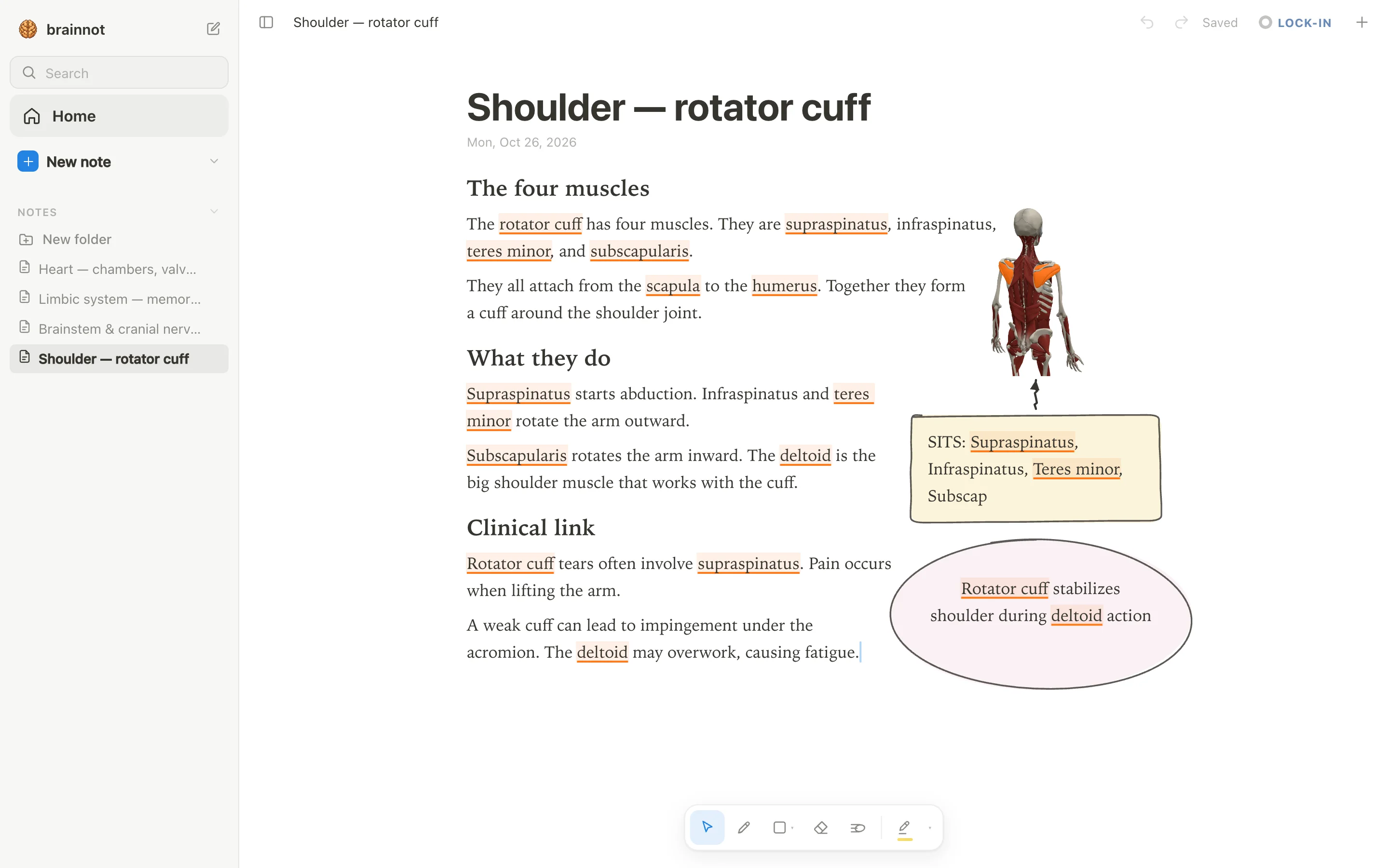
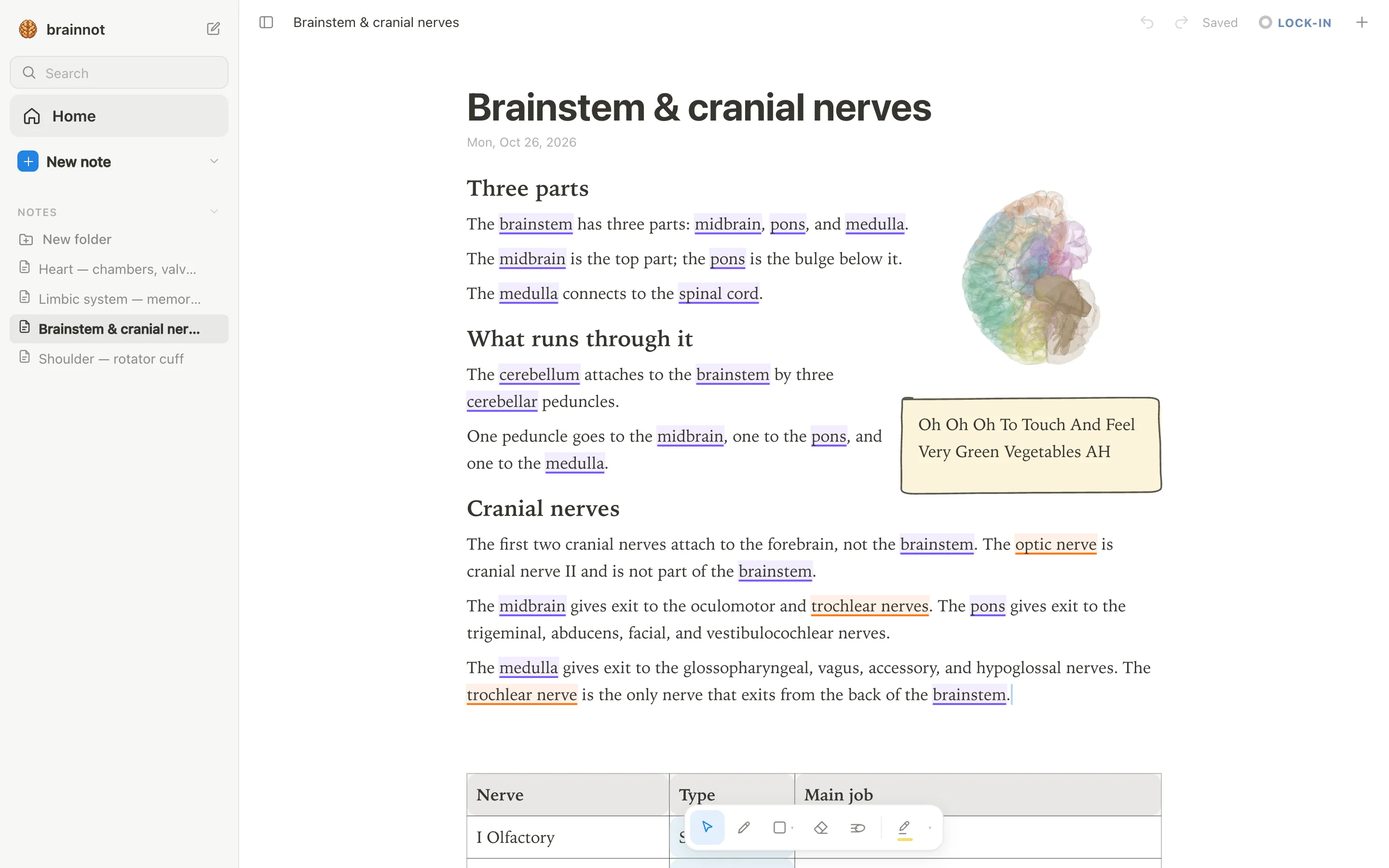
It works by typing a structure’s name — like hippocampus, brainstem, or rotator cuff — and the word lights up in your text, then tap it to open that structure in 3D right above your note. You can put the 3D view into the note as a picture, draw with a pen or Apple Pencil, loop takeaways into boxes, and drop lecture slides in as PDFs. There is no spaced-repetition scheduler like Anki, so use Anki alongside it if you need heavy memorization.
- Good: free while in beta, no account needed to start, sync with Google or Apple.
- Good: 76 brain regions and 6,800 body parts in 3D, opened from the word you typed.
- Good: hand-drawn boxes, arrows, four highlighter colors, and PDF slide import with text reflow.
- Good: one-tap quiz questions about any structure.
- Watch out: no native iPhone or Android app; browser-only on laptop/desktop/iPad.
- Watch out: no handwriting-to-text, no real-time collaboration, no audio recording.
3. Visible Body — best budget 3D with flashcards and quizzes
Visible Body Suite is a dissectible 3D anatomy platform with flashcards and quizzes, priced at $34.99/year for a student subscription, which is less than Complete Anatomy’s full-price first year but more than free anotemy. It has no free tier: the Suite requires a subscription after download, though Visible Body’s free public learn sites exist.
It runs as native iOS/iPadOS, Android, Windows, macOS, and ChromeOS browser apps, one supported device at a time. The separate Human Anatomy Atlas 2027 one-time app is $24.99 on iOS, Mac App Store, and Google Play, but the vendor now funnels most users to VB Suite. Students who want 3D dissection, 3D flashcards, and quizzes without spending much should consider it; if your instructor assigns VB Courseware, it starts at $44.99 for 6 months or 1 year with a 14-day trial.
- Good: full dissectible male and female models, microanatomy, pathology, animations, and AR.
- Good: create and share 3D flashcards, 134 premade decks, and 3D dissection quizzes.
- Good: student subscription is $34.99/year, and Atlas 2027 one-time is $24.99.
- Watch out: no free tier for VB Suite; subscription required after download.
- Watch out: no typed notebook; tags and notes are on structures, and PDF import is not stated.
- Watch out: one supported device at a time for the student subscription.
4. BioDigital Human — best for free 3D anatomy basics
BioDigital Human is a web and native app that gives free, light 3D exploration of core anatomy and physiology models. It suits students who want to browse a male and female 3D body without paying, and schools that need to embed models and quizzes in an LMS. The free Personal plan includes core Anatomy & Physiology content only, with a hard limit of 10 model views per month and up to 5 saved models.
Platforms are native iPhone/iPad and Android apps, plus a web app (human.biodigital.com) that runs in Chrome, Edge, Firefox, or Safari on Windows, Mac, and Chromebook. Human Studio, publishing, and model management are desktop-only. Paid individual plans were retired on May 1, 2026; schools and businesses buy Class, Institution, or Business plans by quote.
- Good: Free Personal plan gives access to 500+ anatomy and physiology models, tours, and quizzes.
- Good: Native iPhone/iPad and Android apps, plus a web app on Windows, Mac, and Chromebook.
- Good: Human Studio and Quiz Builder are included in the free plan, so you can make custom quizzes.
- Watch out: Free plan caps model views at 10 per month; each View, View Tour, or Take Quiz counts.
- Watch out: You can save at most 5 models on the free plan; no publishing or embedding.
- Watch out: No paid individual plan exists anymore, so extra content like 1,000+ health-condition models is only on school or business plans.
5. Kenhub — best for 2D atlas plus spaced-repetition quizzes
Kenhub is a browser-based platform focused on a 2D illustrated atlas, articles, video lessons, and adaptive quizzes. It fits students who prefer 2D illustrations, cross sections, histology, and CT/MRI images over interactive 3D models. The free plan is forever free and includes the atlas, articles, Latin/English terms, sample videos, and sample quizzes.
To use full 141+ hours of videos, 485+ adaptive quizzes, custom exam prep, and 24/7 help, you need a paid plan: $39 per month, $87 for 3 months (that's $29 per month), or $290 lifetime, as archived from the Kenhub pricing page on 2026-09-10. Current live EU prices show EUR 29/month, EUR 66/3 months, EUR 220 lifetime. Kenhub has no native Kenhub course app; the main platform runs in any browser, with add-to-home-screen options on iOS and Android. A separate Daily Anatomy Flashcards app is native on iOS and Android and includes spaced repetition for 500 structures.
- Good: Forever free plan includes the atlas, articles, Latin/English terms, and sample quizzes.
- Good: Large 2D illustrated atlas of 5,000+ HD illustrations, cross sections, histology, and CT/MRI images.
- Good: 485+ adaptive quizzes with spaced repetition and custom exam-prep quizzes on paid plans.
- Watch out: No native Kenhub course app; browser only, with add-to-home-screen rather than a real app.
- Watch out: The main platform has no 3D models; Kenhub's own blog argues against learning with 3D.
- Watch out: No drawing, stylus, or personal notes feature found on vendor pages.
6. Anki — best for spaced repetition on any budget
Anki is the classic spaced-repetition flashcard engine for heavy, long-term memorization, and it is free on desktop, Android, and the web. It suits medical students who need to drill large exam decks, with thousands of shared decks available. The only paid part is AnkiMobile for iPhone and iPad, a one-time $24.99 purchase from the App Store; desktop (Windows, macOS, Linux), AnkiDroid for Android, and AnkiWeb sync are free with no feature tiers.
The free plan's main limit is that AnkiWeb data can be deleted after 6+ months of inactivity, with an email warning and 30 days to act. Anki is local-first and works fully offline, with optional AnkiWeb sync or a self-hosted sync server. It has no anatomy 3D models or long-form note editor; it is built for flashcards with rich text, images, cloze, image occlusion, and the FSRS scheduler.
- Good: Desktop, AnkiDroid, and AnkiWeb are free and open source with no feature tiers.
- Good: Mature spaced-repetition engine with built-in FSRS scheduler, native image occlusion, and add-ons.
- Good: Large shared-deck ecosystem for medical exams, plus AnkiMobile scratchpad with Apple Pencil on iPad.
- Watch out: No 3D anatomy models; you pair it with an atlas or anotemy for visual context.
- Watch out: AnkiWeb data is deleted after 6+ months of inactivity on the free account, with a warning.
- Watch out: The official iOS app AnkiMobile costs $24.99 one-time; no free iOS version.
Side-by-side comparison
This table compares the six apps we covered. Prices reflect the cheapest individual option available in late 2026; some prices are geo-dependent or require institutional quotes. anotemy is free while in beta and runs in a modern browser on laptop, desktop, and iPad, with no native iPhone or Android app.
| App | Platforms | 3D anatomy | Notes | Quizzes or flashcards | Price |
|---|---|---|---|---|---|
| Complete Anatomy | Native iPad, iPhone, Mac, Windows, Android; web institutional only | Yes, full male+female, microanatomy, radiology | Sketch/text on model, Screens, no notebook | Quizzes yes, no flashcards | $39.99 first year then $74.99/yr (Student); free 3-day trial |
| anotemy | Browser on laptop/desktop and iPad; no native app | Yes, 76 brain regions and 6,800 body parts opened from typed words | Full note-taking with PDF import, drawing, highlights, hand-drawn boxes | One-tap quick questions on structures, no spaced repetition | Free while in beta (start without account; Google/Apple sign-in to sync) |
| Visible Body | Native iOS/iPadOS and Android; browser on Windows, macOS, ChromeOS | Yes, dissectible male/female, microanatomy, pathology, AR | 3D Draw on model, tags, Tours, no notebook | Flashcards and quizzes yes | $34.99/yr Student Subscription (one device); Atlas 2027 $24.99 one-time |
| BioDigital Human | Native iPhone/iPad, Android; web on Windows, Mac, Chromebook | Yes, free 500+ A&P models; 1,000+ on org plans | Draw on 2D snapshots, labels in Human Studio, no notebook | Quizzes and Quiz Builder yes, no flashcards | Free Personal plan: 10 model views/month, 5 saved models; no individual paid |
| Kenhub | Browser only (any device); separate Daily Anatomy Flashcards app on iOS/Android | No, 2D illustrated atlas with 5,000+ illustrations | No personal notes feature found | 485+ adaptive quizzes with spaced repetition; Daily Anatomy flashcards app | Free atlas and samples; paid $39/mo, $87/3mo, $290 lifetime (USD archived) |
| Anki | Desktop Windows/macOS/Linux, AnkiDroid Android, AnkiMobile iOS, AnkiWeb browser | No | No long-form notes; flashcard editor only, scratchpad on mobile | Core spaced-repetition flashcards with FSRS, image occlusion, add-ons | Free on desktop/Android/web; AnkiMobile iOS $24.99 one-time |
Which one should you pick?
If you want the deepest 3D atlas on native apps, pick Complete Anatomy. Its student plan is $39.99 for the first year, then $74.99 per year, with no stated free tier after the 3-day trial; the full male and female gross model, dissections, and radiology are on iPad, iPhone, Mac, Windows, and Android.
For notes that link your words to 3D anatomy, anotemy is the only one that turns typed terms like 'hippocampus' or 'heart' into tappable 3D views inside your note. It is free while in beta, runs in a modern browser on laptop, desktop, or iPad, and includes 76 brain regions and 6,800 body parts, drawing, PDFs, and a quick quiz; there is no native iPhone or Android app.
On a tight budget, Visible Body Suite is the cheapest paid 3D option at $34.99 per year for students, but BioDigital's free plan gives 500 core anatomy models with a limit of 10 model views per month and 5 saved models. Anki's desktop, AnkiDroid, and AnkiWeb sync are completely free, though the iOS AnkiMobile app costs $24.99 once.
For cramming with spaced repetition, Kenhub's 485+ quizzes are adaptive and built for exam prep, but paid plans start at $29 per month or $290 one-time, while Anki is free except on iOS and has the most flexible scheduler. anotemy's quick quiz is a lighter on-the-spot check, not a full spaced-repetition system.
Prices and features checked on 26 October 2026 on each one's own site: Complete Anatomy · Visible Body Suite (incl. Human Anatomy Atlas, Courseware) · BioDigital Human · Kenhub · Anki (desktop) + AnkiWeb + AnkiMobile + AnkiDroid.