 anotemy
Sign in
Try it free
Cranial Nerves Mnemonic: 12 Nerves in Order
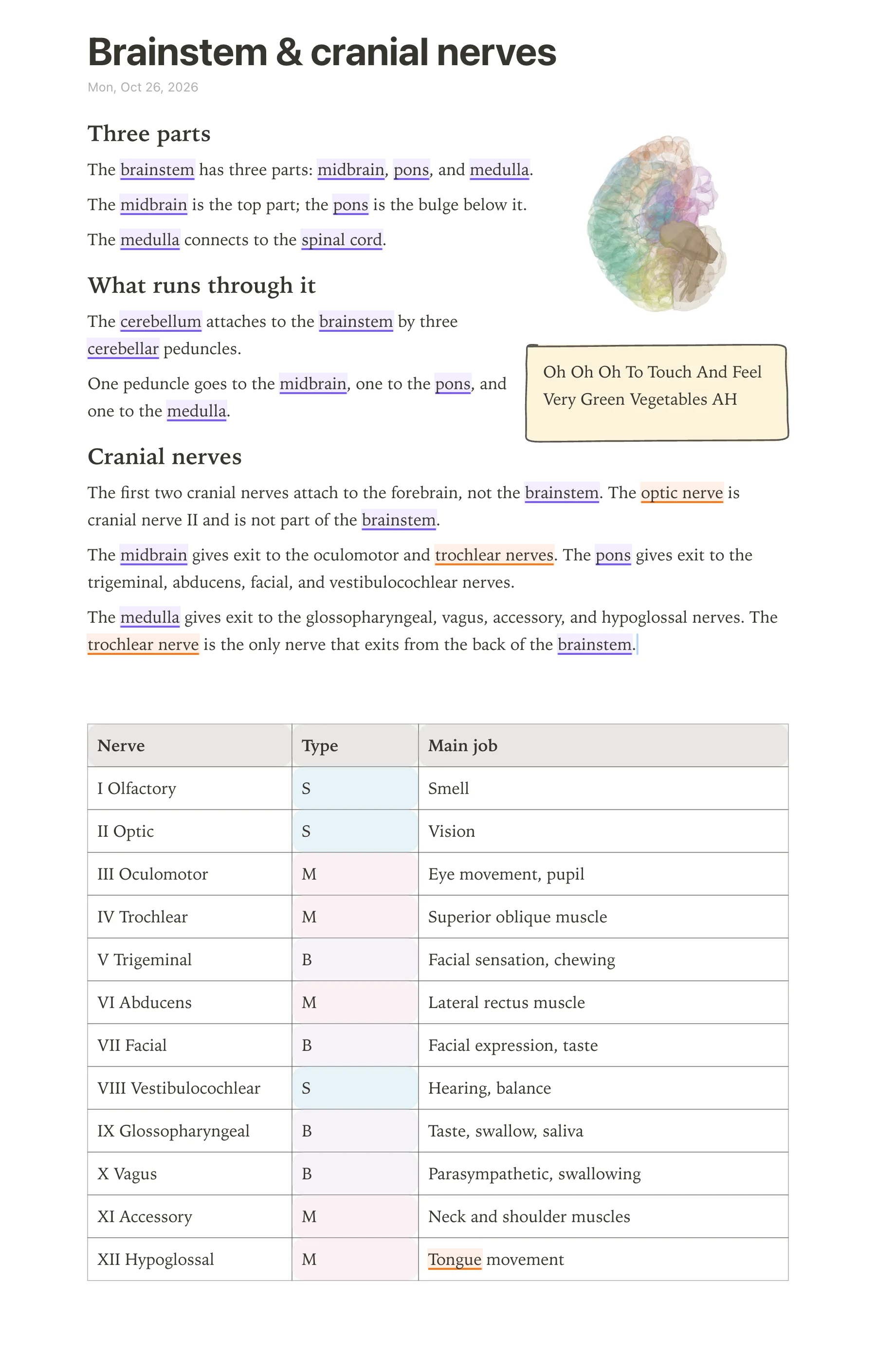
The mnemonic "Oh Oh Oh To Touch And Feel Very Green Vegetables AH" gives the first letter of each of the 12 cranial nerves in order from I to XII. Use the table to match each word to its nerve, and the list after the table for whether each is sensory, motor, or both.
The mnemonic for the names
The classic mnemonic for the 12 cranial nerves in order is "Oh Oh Oh To Touch And Feel Very Green Vegetables AH". Each word in the phrase starts with the same letter as the corresponding cranial nerve, from olfactory (I) to hypoglossal (XII). The last two letters, A and H, are often written together as AH and stand for the accessory and hypoglossal nerves.
To use it, say the phrase aloud and associate each word with the nerve name. For example, 'Oh' for olfactory, 'To' for trochlear, and so on. The mnemonic does not tell you whether a nerve is sensory, motor, or both, so you need a separate way to remember that, such as the list of function types provided after the table on this page.
anotemy helps you take notes on this mnemonic. Type 'brainstem' in a note and the word lights up; tap it to see the brainstem in 3D, which is where most cranial nerves attach.
What each word stands for
Here is the mapping from each word of the mnemonic to the cranial nerve it represents, in order from I to XII. The table also lists the nerve's function type: sensory only, motor only, or both.
Note that the final 'AH' in the phrase is two words: 'A' for the accessory nerve (XI) and 'H' for the hypoglossal nerve (XII).
For function type, here is the list in order: I olfactory: sensory; II optic: sensory; III oculomotor: motor; IV trochlear: motor; V trigeminal: both; VI abducens: motor; VII facial: both; VIII vestibulocochlear: sensory; IX glossopharyngeal: both; X vagus: both; XI accessory: motor; XII hypoglossal: motor. 'Both' means the nerve carries both sensory and motor fibers.
| Number | Nerve | Word of the mnemonic |
|---|---|---|
| I | Olfactory | Oh |
| II | Optic | Oh |
| III | Oculomotor | Oh |
| IV | Trochlear | To |
| V | Trigeminal | Touch |
| VI | Abducens | And |
| VII | Facial | Feel |
| VIII | Vestibulocochlear | Very |
| IX | Glossopharyngeal | Green |
| X | Vagus | Vegetables |
| XI | Accessory | A |
| XII | Hypoglossal | H |
Sensory, motor or both
The function mnemonic is 'Some Say Marry Money But My Brother Says Big Brains Matter More.' Each word starts with S, S, M, M, B, M, B, S, B, B, M, M, which stands for sensory, sensory, motor, motor, both, motor, both, sensory, both, both, motor, motor. That sequence matches the twelve nerves in order, from olfactory (I) to hypoglossal (XII).
Use the table below to check yourself. The column S/M/B tells you whether the nerve is sensory, motor, or both sensory and motor.
| Number | Nerve | S/M/B |
|---|---|---|
| 1 | Olfactory | Sensory |
| 2 | Optic | Sensory |
| 3 | Oculomotor | Motor |
| 4 | Trochlear | Motor |
| 5 | Trigeminal | Both |
| 6 | Abducens | Motor |
| 7 | Facial | Both |
| 8 | Vestibulocochlear | Sensory |
| 9 | Glossopharyngeal | Both |
| 10 | Vagus | Both |
| 11 | Accessory | Motor |
| 12 | Hypoglossal | Motor |
Make it stick
Active recall beats rereading. Test yourself with the nerve list and the function column until you can produce both from a blank page.
- Say the mnemonic aloud, then cover the table and write all twelve nerves in order. Check against the table and mark any mistake.
- Cover just the S/M/B column and say each nerve's function before revealing it. Then reverse: cover the names and recall which nerve matches each function.
- Draw where each pair of nerves leaves the brainstem. In anotemy, tap optic or trochlear to see its 3D position, then sketch the pathway with the pen, mouse, or Apple Pencil. The text makes room for whatever you draw.
- Make a anotemy note with a three-column table: number, nerve, function. Fill in the function column from memory before checking, and loop a takeaway to turn it into a box.
- Use anotemy's quiz on optic or trochlear for quick questions about those structures, and pair it with Anki for spaced repetition of the whole list, because anotemy has no spaced-repetition scheduler.
Put it in your notes
In anotemy, start a note and type 'Cranial nerves' as a heading, then make a table with three columns: number, nerve, and S/M/B. anotemy tints typed anatomy words: brain structures get a violet underline and body structures get an orange underline. In your cranial nerve table, optic and trochlear are recognized and will underline; most other nerve names stay plain text because anotemy knows 76 brain regions and 6,800 body parts, and only optic and trochlear are among the cranial nerves it links to a 3D model. Tap the underlined word to open that nerve in 3D, then use the camera icon to drop the view into the note as a cut-out picture, and the text wraps around it. Highlight the S/M/B column with four highlighter colors (yellow, green, blue, pink) to color-code sensory, motor, and both. Loop the mnemonic line to turn it into a box, and add a hand-drawn brainstem sketch with the pen or Apple Pencil—the text makes room for whatever you draw. Drop your lecture slides in as a PDF on the side rail; the text reflows around the table. Print with ⌘P lays the note out on A4.