 anotemy
Sign in
Try it free
Rotator Cuff Mnemonic: SITS Muscles
Use SITS: supraspinatus, infraspinatus, teres minor, subscapularis. Supraspinatus abducts the arm, infraspinatus and teres minor laterally rotate, and subscapularis medially rotates.
The mnemonic
SITS spells the four rotator cuff muscles from superior to inferior: supraspinatus sits on top of the scapular spine, infraspinatus fills the fossa below it, teres minor hugs the lateral border just below infraspinatus, and subscapularis lines the front of the scapula. Say the letters S-I-T-S as you trace the muscles from top to bottom on a shoulder model or a diagram, and the order locks in because each letter starts the next muscle's name.
The mnemonic works by giving you the complete list in order, which is exactly what a viva or multiple choice question often asks. If you can write S, I, T, S down the left margin, you can expand each letter into the full muscle name without missing the subscapularis on the anterior side.
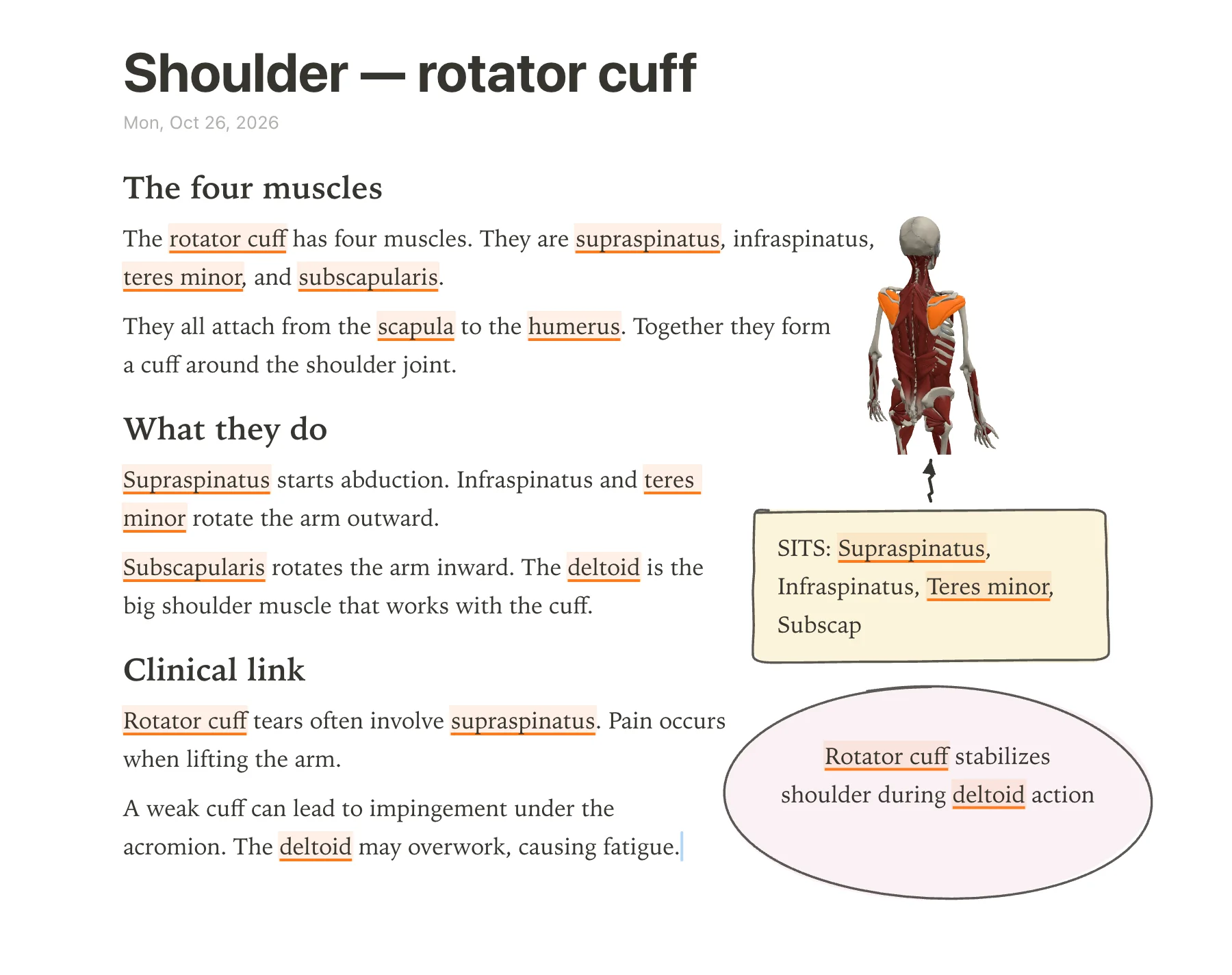
anotemy turns typed anatomy words into links: type “rotator cuff” or any of the four muscle names and the word lights up in orange. Tap the word to open that structure in 3D, and the model stays above the note while you draw. Then loop a SITS box around the list and a pink takeaway bubble to make the mnemonic visual.
What each muscle does
Each rotator cuff muscle crosses the glenohumeral joint and helps hold the humeral head in the glenoid. The table below gives the main action and the nerve supply for each muscle in SITS order, from supraspinatus down to subscapularis. A common exam trap is naming only three muscles, so the table is worth memorizing as a set.
Notice that supraspinatus and infraspinatus share the suprascapular nerve, while teres minor is served by the axillary nerve and subscapularis by both the upper and lower subscapular nerves. This pattern is a useful second layer to the mnemonic: the first two SITS muscles are suprascapular, the third is axillary, and the fourth is subscapular. When you write a note in anotemy, the table tool can lay out these rows, and the 3D view lets you rotate each muscle to see where its fibers pull.
| Muscle | Action | Nerve |
|---|---|---|
| Supraspinatus | Initiates abduction of the arm and assists the deltoid after the first 15 degrees | Suprascapular nerve |
| Infraspinatus | Main external rotator of the arm; also helps stabilize the shoulder joint | Suprascapular nerve |
| Teres minor | External rotation and weak adduction, especially with the arm abducted | Axillary nerve |
| Subscapularis | Internal rotation of the arm and anterior stability of the shoulder | Upper and lower subscapular nerves |
Make it stick
The rotator cuff is a set of four muscles that wrap the head of the humerus. Three of them sit on the back of the shoulder blade, and one sits on the front.
Use these two points together: the front/back split tells you where each muscle sits, and the size trick keeps teres minor in the cuff and teres major out.
When you draw the shoulder, put subscapularis on the rib side of the scapula. The other three sit on the back, and you can list them from top to bottom: supraspinatus, infraspinatus, teres minor.
- Subscapularis is the only rotator cuff muscle on the front of the scapula. It medially rotates the arm.
- Supraspinatus, infraspinatus, and teres minor are on the back. Supraspinatus abducts the arm, infraspinatus and teres minor laterally rotate it.
- The 'small t, big T' trick: teres minor is the small muscle, teres major is the big muscle. Teres minor is part of the rotator cuff; teres major is not.
- Remember: teres minor sits above teres major, and only teres minor inserts on the greater tubercle.
- For a quick check: subscapularis is the only one you can't see from the back, and teres minor is the only teres in the cuff.
Put it in your notes
In a anotemy note, type 'rotator cuff' and the words light up in orange because anotemy recognizes body structures. Tap the word to open the rotator cuff in 3D, then draw or type a SITS box with the four muscles. Use the pen to loop the box so it becomes a bordered box, and draw a hand-drawn arrow from the box up to the 3D model of the back with the cuff muscles lit orange. anotemy lets you place that 3D view into the note as a picture cut to the model's edges, and the text flows around it, so the arrow stays attached to the model in your notes. You can also loop a takeaway text like 'SITS' with the pen to box it, and the text makes room for whatever you draw. The app is free while in beta, and you can start writing without an account.