 anotemy
Sign in
Try it free
How to Draw the Brachial Plexus
Draw the brachial plexus in five stages using the mnemonic Randy Travis Drinks Cold Beer: roots, trunks, divisions, cords, branches. Start with five roots C5–T1, join them into three trunks, split each trunk into anterior and posterior divisions, regroup into three cords, then draw the five major terminal branches.
What you're drawing
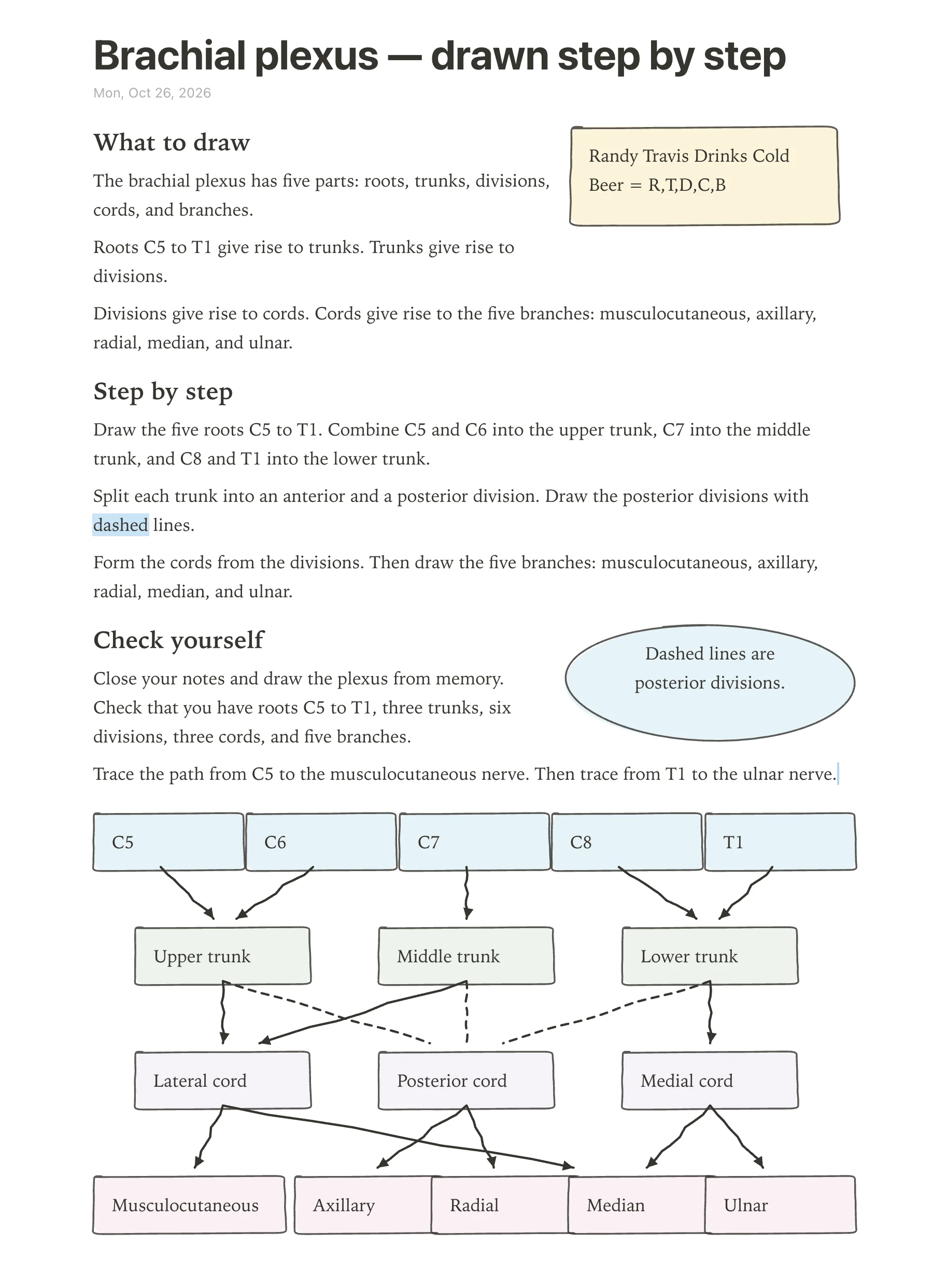
The brachial plexus is a network of nerves from the spinal cord that supplies the upper limb. You draw it as five parts in order, remembered by the mnemonic Randy Travis Drinks Cold Beer: roots, trunks, divisions, cords, branches.
The five roots come from spinal nerves C5, C6, C7, C8, and T1. They join to form three trunks: upper (C5–C6), middle (C7), and lower (C8–T1). Each trunk splits into an anterior and a posterior division. The divisions regroup into three cords: lateral, posterior, and medial. Finally, the cords give off the five major terminal branches: musculocutaneous, axillary, radial, median, and ulnar.
When you draw the plexus in anotemy, you can use the pen tool to sketch each stage and type labels next to them. The text reflows around your drawing, so the diagram stays clear and readable.
Step 1: Draw five roots in a row
Begin by drawing five short horizontal lines in a row from left to right. Label them C5, C6, C7, C8, and T1. These are the roots of the brachial plexus, coming from the spinal cord.
Keep the lines evenly spaced and roughly parallel. In anotemy, draw them with the pen or mouse, then add small text labels above or below each root. You can loop each root into a hand-drawn box to make the labels stand out.
Step 2: Join roots into three trunks
Now draw three vertical or slanted lines that connect pairs of roots. Connect C5 and C6 together into the upper trunk. Leave C7 alone as the middle trunk. Connect C8 and T1 into the lower trunk.
Label each trunk: upper, middle, lower. The upper trunk is lateral, the lower trunk is medial, and the middle trunk sits between them. In anotemy, you can draw the connecting lines and then highlight the trunk labels with a colored highlighter to separate them from the roots.
From this point, you will continue with divisions, cords, and branches, but getting the roots and trunks correct first makes the rest of the drawing faster and more accurate.
Step 3: Divide trunks into divisions
Each of the three trunks—upper, middle, and lower—splits into an anterior and a posterior division. Draw six short lines descending from the trunks: three solid lines for the anterior divisions and three dashed lines for the posterior divisions. The dashed lines are a visual reminder that these divisions will travel behind the axillary artery and join together into the posterior cord.
Keep the divisions short and parallel, drawing one solid and one dashed line from each trunk. From the upper trunk, draw one solid and one dashed line; do the same from the middle and lower trunks. The three solid lines will later feed the lateral and medial cords, while the three dashed lines converge to form the posterior cord.
A classic mnemonic for the brachial plexus order is 'Real Texans Drink Cold Beer'—roots, trunks, divisions, cords, branches. For the divisions, remember that the posterior divisions are the 'cold beer' heading behind, and the anterior divisions go to the warmer front. Drawing them dashed keeps that visual separation.
Step 4: Form lateral, medial, posterior cords
The anterior divisions of the upper and middle trunks join to form the lateral cord, while the anterior division of the lower trunk continues alone as the medial cord. All three posterior divisions—from upper, middle, and lower trunks—unite to form the posterior cord. Draw these cords as three vertical columns below the divisions: lateral cord on the outer side, medial cord on the inner side, and posterior cord behind them.
The cords are named for their position relative to the axillary artery: lateral cord lies lateral to the artery, medial cord lies medial, and posterior cord lies behind it. On a two-dimensional diagram, place the lateral cord on one side, the medial cord on the opposite side, and the posterior cord slightly behind and between them, often shown as a line just posterior to the artery.
Step 5: Draw terminal branches
From the lateral cord, draw the musculocutaneous nerve heading laterally into the arm. From the posterior cord, draw the axillary nerve going posteriorly around the surgical neck of the humerus and the radial nerve descending behind the arm. From the medial cord, draw the ulnar nerve going medially down the arm.
The median nerve forms from two roots: one from the lateral cord and one from the medial cord, which join to make an “M” shape in front of the axillary artery. Draw that M as a loop from each cord meeting in the middle, then continuing down as a single line. If you are practicing this in anotemy, you can draw these branches with a pen or mouse and use a highlighter color, such as pink or blue, to mark the posterior divisions from Step 3, so the dashed versus solid distinction stays clear while you study.
Check your drawing
After you finish, use this table to verify each terminal branch against its cord and spinal root contributions. If you draw in anotemy, you can add this table to your note while sketching.
| Branch | Cord | Roots |
|---|---|---|
| Musculocutaneous | Lateral cord | C5–C7 |
| Axillary | Posterior cord | C5–C6 |
| Radial | Posterior cord | C5–T1 |
| Median | Lateral and medial cords | C5–T1 |
| Ulnar | Medial cord | C8–T1 |
Common mistakes
Even with a good method, small errors slip in. Here are the mistakes I see most often, and how to fix each one. Because anotemy lets you draw the plexus as boxes and arrows but does not include the plexus itself in its 3D library, you sketch it yourself and can annotate each fix directly on your drawing.
- Drawing the ulnar nerve from C7 instead of C8–T1. Fix: Label the lower trunk C8–T1, and remember the ulnar nerve comes only from that lower trunk via the medial cord.
- Giving the musculocutaneous nerve roots C6–C7 only. Fix: It is C5–C7; the lateral cord carries C5, C6, C7 from the upper and middle trunks.
- Forgetting that the median nerve has two heads (lateral and medial cords). Fix: Draw a small loop or "M" where lateral and medial cords join to form the median nerve, and label it C5–T1.
- Swapping anterior and posterior divisions: the posterior divisions from all three trunks join to form the posterior cord. Fix: Color posterior divisions one color, anterior divisions another, so the posterior cord receives only posterior divisions.
- Making the axillary nerve a branch of the radial nerve. Fix: Draw axillary and radial as separate branches from the posterior cord, with axillary above radial.
- Not checking cord positions: lateral cord is most lateral, medial cord is most medial, posterior cord is behind. Fix: Label cords in order lateral, posterior, medial from lateral to medial, and check with your table.